What Is a True Line in Sports Betting?
Every sportsbook posts a line on every game. But that line isn't designed to predict the outcome — it's designed to balance the book's risk and guarantee their profit through the vig.
A true line is different. It's what the spread, total, or moneyline should be based purely on the data — team strength, pitching matchups, rest, park factors, bullpen quality, and dozens of other variables — with no vig, no liability management, and no public bias baked in.
When you compare a true line to a sportsbook's posted line, you find the gap. That gap is where the edge lives.
How sportsbooks set their lines
Sportsbooks don't set lines to be accurate. They set lines to attract equal action on both sides.
If the public loves the Yankees, the book shades the line toward New York — not because the Yankees are better than the math says, but because it balances their exposure.
This creates a predictable pattern: popular teams and heavy favorites tend to be overpriced. Less popular teams and underdogs tend to be underpriced. The book doesn't care — they collect the vig either way.
How a true line is different
A true line starts with data, not money flow. At Dr. TrueLine, our MLB model uses multiple categories of variables to calculate what each team's win probability actually is.
That includes pitching quality blended across multiple seasons with proprietary dampening, team offensive strength, bullpen quality and availability, park factors, weather, matchup dynamics, lineup strength, and several regression adjustments that catch teams riding unsustainable luck.
The model converts those calculations into a win probability, then into a moneyline. That moneyline — free of vig and book manipulation — is the true line.
Finding the edge
Once you have a true line, finding edges is straightforward: compare it to what the sportsbook is offering.
If our model says a team's true moneyline is +110 but the book is offering +135, that's a mispriced underdog. You're getting better odds than the math justifies. Bet that consistently and the math works in your favor over time.
If our model says a team's true line is -130 but the book has them at -160, the book is overcharging. Even if the team wins, you paid too much juice.
Our model flags these as No Play — games where the favorite is overpriced and there's no value on either side.
Why this matters more than picks
Most betting services sell picks: “Bet the Yankees -1.5.” But a pick without context is meaningless. At what odds? With what edge? How confident is the model?
A true line gives you the full picture. You see our probability vs the book's probability. You see the edge percentage. You see whether the game qualifies as a Best Bet, an Undervalued play, or a No Play.
You can even adjust the odds to match your specific sportsbook and watch the tier update in real time. This is the difference between following someone's tips and understanding why a bet has value.
Why filtering matters
Our research across hundreds of MLB games revealed that not every edge is worth betting. Home picks convert smaller edges into profit because the home environment reduces variance. Away picks need a larger edge before the signal overcomes the noise.
This led to our edge threshold filter: home picks and away picks are held to different thresholds based on our research. Everything below those thresholds is filtered out. The live results for every tier are on the scoreboard, updated as picks are made.
The true line makes this filtering possible. Without knowing what the line should be, you can't know which games are mispriced and which are traps.
See it in action
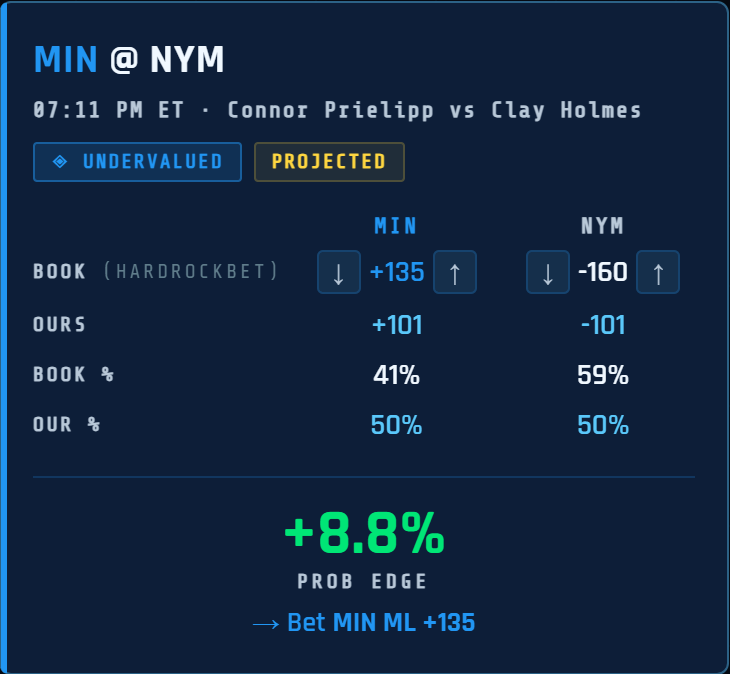
A real pick from Dr. TrueLine — our line vs the book's line, with the probability edge calculated automatically.
Dr. TrueLine publishes a true line for every live game across WNBA, CFB, NFL, and (when active) MLB and NBA. We show our model's probability next to the book's probability, flag the edges, and track every pick on a fully transparent scoreboard, wins and losses, no cherry-picking.